The demo always works. That's the problem. Most enterprise AI dies in the quiet gap between a flawless pitch and a system that survives production data, a procurement review, and a compliance team that has heard every promise before. Here's how you cross it.
If you've read our case for the agentic enterprise, you know the prize: AI that does the work, not just describes it. This is the harder half of the story — how you actually ship it. Because the graveyard of corporate AI isn't full of bad ideas. It's full of impressive prototypes that never made it past the first real workflow.
Why demos die
A demo is a controlled environment. Production is not. The four things that kill an agent between the two are predictable:
- Reliability. A model that's right 90% of the time is a great demo and a terrible unsupervised employee. The last ten percent is where the lawsuits live.
- Trust. Nobody hands a new hire the keys on day one. Asking compliance to do that for a probabilistic system is a non-starter — and they're right to refuse.
- Integration. The demo ran on a clean sandbox. Your reality is a thirteen-year-old CRM, three sources of truth that disagree, and an SSO policy with opinions.
- Change. Even a perfect agent reshapes someone's job. If the people who own the workflow weren't in the room, the system gets quietly routed around.
None of these are model problems. They're systems problems — which is good news, because systems problems have known solutions.
The graveyard of corporate AI isn't full of bad ideas. It's full of impressive prototypes that never met a real workflow.
The core pattern: staged autonomy
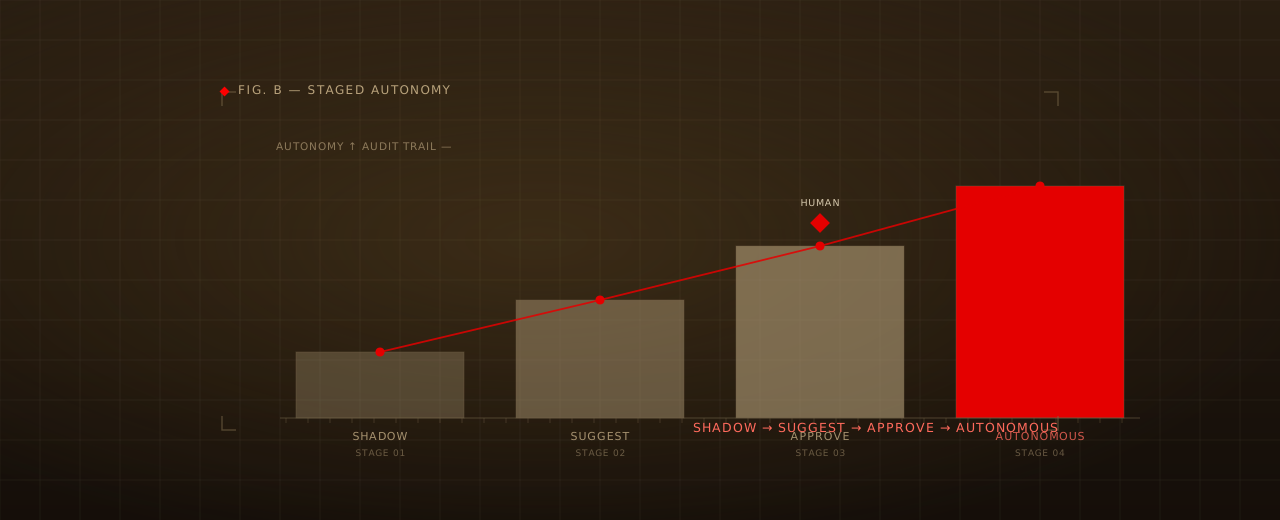
You don't earn trust with a slide. You earn it one stage at a time. The single most useful pattern we deploy is a ladder of autonomy, where the agent's freedom expands only as its track record does:
Stage 01 — Shadow
The agent runs on live data but takes no action. It proposes what it would do, in parallel with the humans still doing the job. You compare. This is where you discover that the messy edge cases are 30% of the volume, not 3% — before any of them reach a customer.
Stage 02 — Suggest
The agent drafts and a human ships. Cycle time drops immediately because reviewing is faster than creating, and every accept-or-edit becomes a labeled training signal that makes the next draft better.
Stage 03 — Approve
The agent acts, but a human signs off at a defined checkpoint before anything irreversible happens — the pricing change goes out, the refund is issued, the email sends. Autonomy is now real, but a person still owns the consequential moment.
Stage 04 — Supervised autonomy
The agent runs the workflow end to end within tight, well-tested bounds, escalating only the genuinely ambiguous cases. Humans supervise the fleet, not each action — reviewing exceptions and metrics, not every send.
The point isn't to rush to Stage 04. It's that each stage delivers value and manufactures the evidence you need to justify the next one. A two-person ops team at one of our clients runs six regions of agent-driven lifecycle campaigns this way — and they got there by climbing the ladder, not skipping it.
The thing that gets you past compliance
An audit trail isn't a feature you add at the end. It's the foundation the whole system stands on. Every perception, decision, tool call, and output an agent produces should be logged, attributable, and reconstructable — so that when someone asks "why did it do that," the answer is a record, not a shrug.
We've watched this single discipline turn a two-year "no" into a "yes." A marketing-operations team had every automation proposal vetoed by compliance for two years. The agent system passed because compliance got a live audit dashboard before the first agent sent a single message. They weren't being asked to trust a black box. They were being handed a window into it.
Guardrails and evaluation
Trust at scale comes from measurement, not vibes. Three mechanisms do most of the work:
- Evals. A growing test suite of real cases the agent must pass before any change ships — your regression tests for behavior, not just code.
- Hard guardrails. Deterministic limits the model cannot override: spend caps, allow-lists of actions, rate limits, and mandatory human checkpoints on anything irreversible.
- Graceful fallback. When the agent is uncertain, the correct behavior is to stop and escalate — not to guess. An agent that knows what it doesn't know is worth more than one that's occasionally brilliant and occasionally catastrophic.
The economics of the human in the loop
Over-supervise and you've automated nothing — you've just added a robot for your humans to babysit. Under-supervise and you've bought tail risk you can't see. The right answer is dynamic: heavy oversight where actions are irreversible or rare, light oversight where they're cheap and reversible, and a steady migration from the former to the latter as the eval pass-rate climbs. Supervision is a dial, not a switch.
An agent that knows what it doesn't know is worth more than one that's occasionally brilliant and occasionally catastrophic.
Don't forget the humans whose jobs change
Every agent you ship rewrites a job description. The operators who used to do the work now direct it — reviewing exceptions, tuning the guardrails, deciding what to automate next. That's a more valuable role, but only if you invest in it. The teams that win treat enablement as part of delivery, not an afterthought: the people closest to the workflow learn to run the agent, so capability compounds inside the company instead of leaving with the consultants. (It's why our training practice is woven through every engagement.)
A rollout that actually ships
You don't need a transformation office. You need one workflow and a disciplined six weeks:
- Weeks 1–2 — Diagnose. Map the workflow, instrument the baseline, and pick the wedge by value over feasibility. If you can't measure today's cost, you can't prove tomorrow's savings.
- Weeks 3–6 — Pilot in shadow, then suggest. A working system on production data, in front of real users, climbing the first two rungs of the autonomy ladder.
- Ongoing — Harden and widen. Move to approve and supervised autonomy as the evals and the audit trail earn it, reviewed against production metrics with leadership monthly.
That's not a thought experiment — it's our engagement model. Fixed scope, production data, a working system in front of real users. Not a slide about one.
Anti-patterns to avoid
- The big bang. Automating an entire department at once. Pick a wedge; earn the next one.
- The science project. Six months of R&D with no production milestone. If it isn't in front of a real user by week six, the goalposts will move forever.
- The black box. Optimizing for a slick demo over an inspectable system. Compliance is not the obstacle to shipping — it's the gate, and the gate opens for transparency.
- The hand-off to nobody. Building a system the internal team can't run. Success is them not needing you.
Production is where AI stops being a press release and starts being a P&L line. The companies that get there aren't the ones with the best demo. They're the ones who treated trust as something you build on purpose — one stage, one workflow, one auditable decision at a time.