For three years, enterprise AI mostly talked. It summarized, drafted, and answered. The next phase doesn't talk — it acts. And the distance between companies that wire AI into the actual work and those still demoing chatbots is about to become structural.
Most boards have now sat through the same meeting a dozen times. A vendor opens a chat window, types a question, and a fluent paragraph appears. It's impressive for about ninety seconds — and then someone asks the only question that matters: so what did it change? Usually, nothing. The paragraph still has to be read, judged, and acted on by a person. The AI advised. The human did the work.
Agentic AI inverts that. An agent is given a goal, not a prompt — and it's wired to take the steps that move the goal forward: pulling data, calling systems, drafting and sending, updating records, escalating when it's unsure. The model is still the engine, but it now sits inside a loop that touches your real tools. That single architectural shift is what turns "interesting" into "operational."
What "agentic" actually means
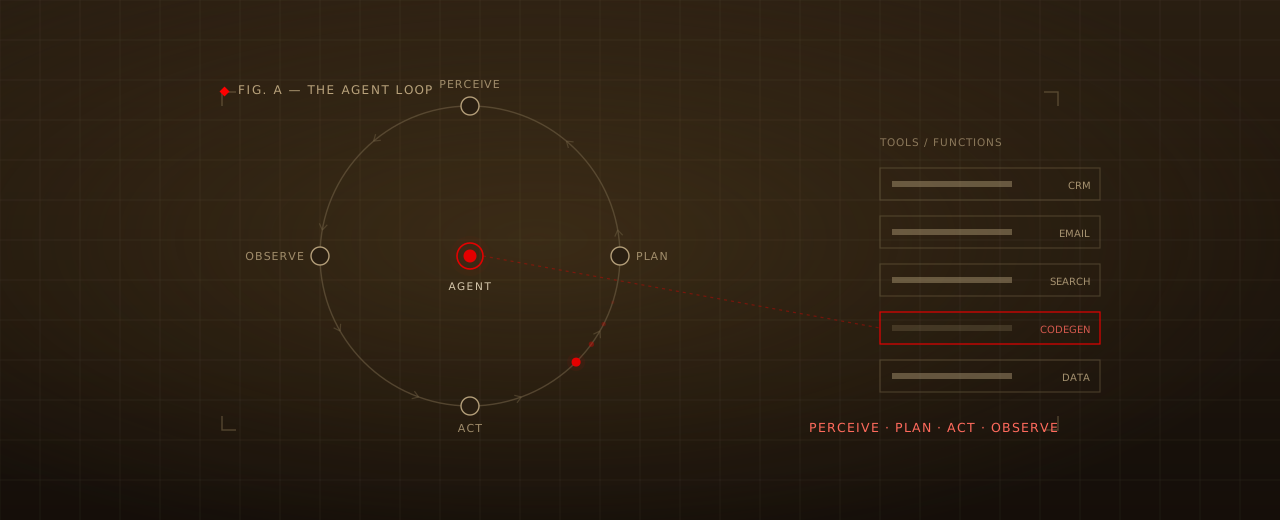
Strip away the marketing and an agent is a simple loop running on top of a capable model. It perceives the current state of a task, plans the next step, acts by calling a tool, then observes the result and goes again — until the goal is met or it hits a guardrail and asks for a human. Give that loop memory, a set of permitted tools, and a clear definition of "done," and you have something that doesn't just describe work. It performs it.
The three ingredients that make it enterprise-grade are unglamorous:
- Tools, not just text. An agent is only as useful as the systems it can touch — your CRM, your data warehouse, your ticketing, your codebase. The intelligence was never the bottleneck. The integrations are.
- Bounded autonomy. Every action an agent can take is a permission you granted. The interesting design question isn't "how smart is it" but "what is it allowed to do unsupervised, and where does it stop."
- An audit trail. A production agent logs every decision and every action, so a human can reconstruct exactly what happened and why. Without that, no regulated enterprise will ever let it near a real workflow — and they shouldn't.
The intelligence was never the bottleneck. The integrations, the permissions, and the audit trail are.
Why the economics change
When AI advises, you save a knowledge worker a few minutes. When AI acts, you remove the task from the queue entirely. That's a different order of magnitude — and it compounds, because agents don't get tired, don't context-switch, and run every hour of every day.
We watched this play out at a global software company that had spent two years stuck. Six regional teams rebuilt the same lifecycle campaigns by hand, fourteen days at a time. Once agents owned the lifecycle — drafting, segmenting, sending, and flagging anomalies for a human — cycle time fell to thirty-six hours and the team got back eleven thousand hours a year. Nobody was "replaced." The work that used to eat a quarter of their week simply stopped being something a person had to do.
Where it lands first
Agentic AI doesn't arrive everywhere at once. It lands where the work is repetitive, data-rich, and measurable — which, in most enterprises, means the commercial and operational core:
- Go-to-market. Agents that score intent, route accounts, and keep the CRM honest turn a static pipeline into a system that re-prioritizes itself every morning. (Our GTM practice lives here.)
- Marketing operations. Lifecycle campaigns, content operations, and reporting are textbook agent territory — high volume, clear rules, auditable outcomes. (See Marketing Automation.)
- Product. Agent workflows and copilots embedded in your own product, built on your stack — not a wrapper around someone else's. (That's Product Development.)
- The back office. Finance close, procurement, support triage, IT operations — anywhere a process is documented well enough to hand to a new analyst is somewhere you can hand part of it to an agent.
Why the gap becomes structural
Here's the uncomfortable part. The advantage from agents isn't a one-time bump — it's a slope. Every workflow you move into production generates data about how that work actually gets done, which makes the next agent easier to build, which frees the team to tackle the next workflow. Organizations that start now don't just get ahead; they get faster at getting ahead.
Meanwhile, the companies waiting for the technology to "settle down" are quietly accumulating a deficit that's hard to see and harder to close. Their competitors aren't shipping better demos. They're operating on a lower cost base, with a workforce that's learned to direct machines instead of doing the machine-able work themselves.
Organizations that start now don't just get ahead. They get faster at getting ahead.
The honest constraint
None of this is free, and anyone who tells you agents "just work" is selling the ninety-second demo. Agents fail in ways software doesn't: they're probabilistic, they can be confidently wrong, and a system that takes real actions can take real wrong actions. Trust is earned one workflow at a time, through staged autonomy, evaluation, and the kind of audit trail your compliance team can actually love. That's a whole discipline of its own — and it's the difference between a pilot that impresses and a system that ships. (We wrote the field guide for exactly that: From Pilot to Production.)
What to do in the next quarter
You don't need a moonshot. You need a wedge — one workflow with a clear owner, clean enough data, and a number a finance team would recognize. Then:
- Pick the workflow by value over feasibility, not by how exciting it sounds.
- Instrument the baseline before you build anything, so the result is undeniable.
- Ship it into production behind a human checkpoint, then widen the autonomy as trust accrues.
- Train the team that owns the workflow to direct the agent — capability that compounds long after the first deployment.
Every company is going to be remade by AI. The only real decision is whether you author the remaking or inherit someone else's. The agentic enterprise isn't a destination you arrive at — it's a habit you start.