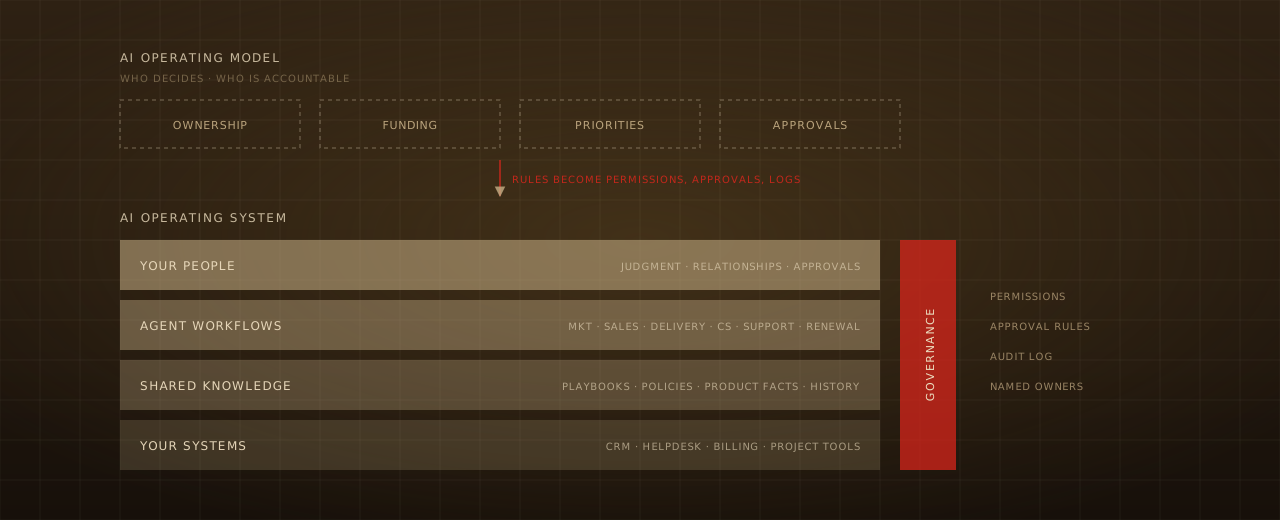
An AI operating model is the organizational side of AI: who owns it, how it's funded, who sets priorities and which risks need approval. An AI operating system is the working layer underneath, built from connected systems, shared knowledge, agent workflows, permissions and audit logs. In our experience most companies build one and neglect the other.
People use the two terms interchangeably. Vendors stretch both to cover whatever they happen to be selling. In a leadership meeting that causes real confusion. One person means an org chart. Another means a software purchase. We use the definitions above because they split the subject into two decisions that usually belong to different people.
What is an AI operating model?
It's a set of decisions about people, money and authority. Most of it fits on a few pages. The questions it answers look like these:
- Who on the leadership team is accountable for AI results? Who owns each workflow once it's live?
- Is AI work paid for from a central budget, by each function, or some mix of the two?
- Who sets priorities, and who's allowed to add a workflow to the backlog or pull one off it?
- Which actions always need human approval, and who gives it?
- Which roles change? What training do those people get?
None of this needs software. You can have a perfectly clear AI operating model with no AI in production at all, which, in our experience, is where companies that plan first often end up sitting for a while before anything ships.
What is an AI operating system for a business?
The operating system is the part that runs. In our AI Business OS program we describe it in layers, starting from the bottom:
- Your systems. Think CRM, helpdesk, billing, project tools, the knowledge base: whatever you already run.
- Shared knowledge. Playbooks, policies, product facts, customer history, all kept in one place that agents and staff both read.
- Agent workflows that handle the repetitive steps (research, drafting, data entry, routing, reporting) across the whole customer lifecycle: marketing, sales, delivery, customer success, support, renewal.
- Your people, on top. Judgment stays with them. So do relationships and approvals.
Governance runs through every layer. In practice that means roles, permissions and approval rules. It also means an audit log of what each agent read and did, and who approved it. Most of an AI operating system gets built from tools you already own; what's new is the shared knowledge layer and the agent workflows, with governance tying the two together.
AI operating model vs AI operating system, side by side
| Question | AI operating model | AI operating system |
|---|---|---|
| What it is | Decisions about ownership, funding, priorities and risk | The connected systems, knowledge, agents and controls that do the work |
| The question it answers | Who decides, and who is accountable? | What runs, on which data, with which permissions? |
| Typical owner | CEO or COO, with the leadership team | COO or CTO, with a named owner for each workflow |
| What it produces | Decision rights, budget, approval policy, training plan | Operating map, workflow backlog, live agent workflows, knowledge layer, audit logs, dashboard |
| How it fails | Nobody owns results, so pilots never get funded past the demo | Agents run on scattered data with no logs, so nobody trusts them |
| How often it changes | Yearly, or when leadership changes | Monthly, as workflows are tuned and added |
Where do mid-market companies get stuck?
Usually on one side of the gap.
Some companies write the operating model and stop there: they set up a steering group, publish an acceptable-use policy, maybe name a center of excellence, only to find a year later that no workflow runs any differently. The model has nothing to govern.
Others go straight to tools. Each team buys its own assistant. A few automations get wired up. Context gets lost at every handoff between teams, so when something goes wrong nobody can say which agent did it or who approved it, and compliance ends up shutting the whole thing down.
Mid-market companies feel both problems sharply because they can't staff a separate AI department, so the same few leaders end up owning the model and the system at the same time, which we'd count as an advantage as long as they run the two as one program.
How do the two fit together?
The model sets the rules. The system enforces them. Take a rule from the model like "anything that moves money needs a person to approve it." Inside the system that one sentence turns into an approval step in the workflow, a permission the agent simply doesn't have, and a line in the audit log that shows who signed off. It works in the other direction too: every workflow you add to the system raises model questions. Who owns it? Who pays? How will its results be judged?
You can see the same link in how agents earn autonomy. Each one starts in shadow mode. After that it runs with human approval, getting more freedom only once the evidence supports it. Our field guide to staged autonomy and audit trails walks through that ladder step by step.
In what order should you build them?
Together, one workflow at a time. Here's the sequence we use. Your staff are involved at every step.
- Map the operation. Interview the people who do the work and shadow them on real tasks, then take an inventory of the systems and data, deciding in the meantime who on the leadership team is going to own AI results.
- Score and rank the workflows on hours, errors, cycle time and revenue impact, noting risk and data readiness beside each one, so leadership has what it needs to set the order, which is the first real operating-model decision you'll make.
- Design each agent with people in the loop (what it does, what it can touch, where a person approves) and write those approval rules into policy as you go, so the policy keeps pace with what's actually running.
- Build into the systems you already run, starting in shadow mode and moving to human approval well before anyone starts talking about wider autonomy for the agent.
- Run, measure and tune. Review results with leadership every month while you keep working down the backlog.
Steps 1 and 2 are the core of a readiness assessment. Want to check where you stand before that? Our AI readiness assessment checklist has 20 questions you can answer in an afternoon.
By the third workflow most of the operating model is already written, because each build forced a decision about ownership, approval or funding that somebody had to make before the work could go live. We'd argue that produces a better document than one drafted in a workshop before anything ran. If you'd like to talk through where your first workflow is, book the free 30-minute call.
AI operating model and operating system FAQ
What is an AI operating model?
The organizational side of AI. It covers who's accountable for results, how AI work is funded, who sets priorities, which actions need human approval and which roles change.
What is an AI operating system for a business?
The working layer that does the work. It's made of your existing systems, a shared knowledge layer and agent workflows across the customer lifecycle, with governance (permissions, approval rules, an audit log) running through all of it.
Is an AI operating system a product you buy?
No. Most of it is built on tools you already run, such as your CRM or your helpdesk or billing system; the new pieces are the shared knowledge layer and the agent workflows, plus the governance over them.
Who should own the AI operating model?
A member of the leadership team, usually the CEO or COO, though every live workflow should also have its own named owner somewhere on the team.
Which should we build first?
Build them together. Start with a map of how the company runs and a single workflow, then make the operating-model decisions that workflow forces. Not sure which one? A free 30-minute call is a good place to work that out.