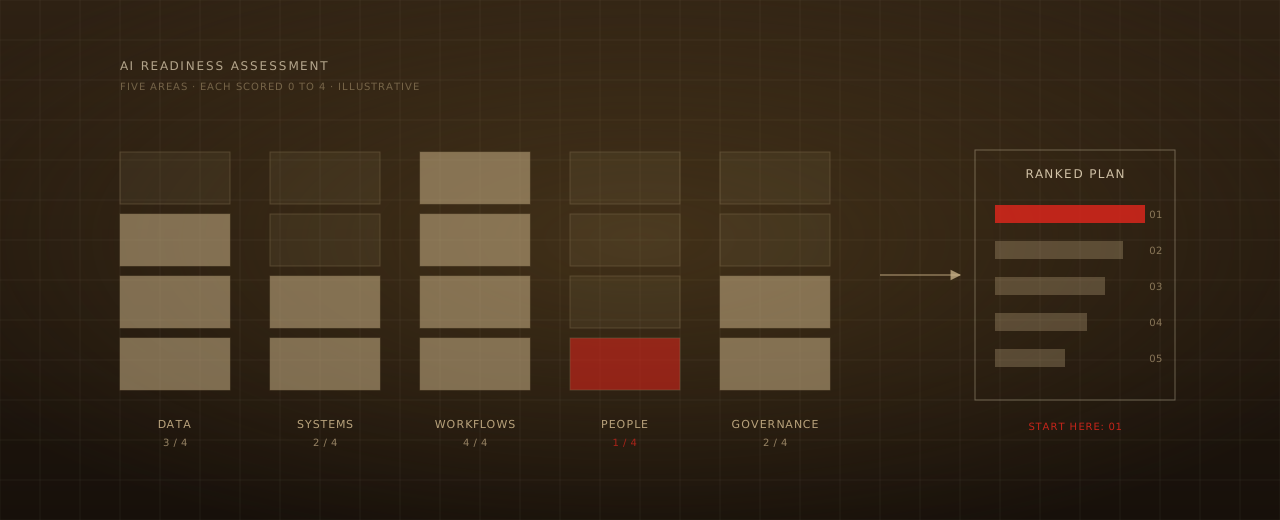
An AI readiness assessment is a short, fixed-scope review of five parts of a company: data, systems, workflows, people and governance. It tells you where AI will pay back first and what's keeping it out of production, so you come away knowing where to start, with a ranked plan leadership can fund and a board can read.
Most mid-market companies already have AI somewhere. Someone in marketing pays for a writing tool. A few engineers use coding assistants. And the pilot from last spring is, technically, still running. What leadership usually doesn't have is a clear view of where AI would move the numbers they actually watch, along with an honest list of whatever is standing in the way of that happening. An assessment gives you both. It should take weeks to produce.
Who needs an AI readiness assessment, and when?
You probably need one if a few of these sound familiar:
- AI spend keeps growing. Nobody can say what it returns.
- Several teams run pilots. No two of them share tools, data or rules.
- The board wants an AI plan. Your leadership team can't agree where to start.
- A vendor has pitched a platform and you'd like to know whether your data could even feed it.
- A pilot looked great in a demo, then stalled before it got anywhere near real customers or real money. (We wrote about that gap in our field guide to getting AI agents into production.)
The cheapest time to run one is before a big software purchase or a reorganization, since the findings often change the order of both; the most expensive time is right after a platform contract has been signed, when the assessment tends to turn into a search for reasons to justify what you just bought.
What does an AI readiness assessment cover?
We look at five areas. Any one of them can stop a project, so a review that only checks data quality will usually find the easy problem and walk right past the one that's actually going to hold you up, which is the reason we don't stop at the data.
Data
Can the information a workflow needs be found and trusted? Can a system read it? We often find customer records split three ways: the CRM, the billing tool, somebody's spreadsheet. That's fixable. It also changes what you build first.
Systems
Which tools hold the work today, and can they be connected? We check whether the APIs are usable and how permissions and single sign-on are set up (noting the age of the core systems while we're at it), since an agent can only act inside the systems it's allowed to reach.
Workflows
Which pieces of repeated work cost the most hours, cause the most errors or slow down revenue? This is where the ranked list comes from. Each workflow gets a score on hours spent, error rate, cycle time and revenue impact, and its risk and data readiness get written down right next to that score so they travel with it.
People and skills
Who'll own each AI workflow once it's live, and do they have the time and skills to run it? If nobody on your side owns a workflow, it decays after launch no matter how good the build was.
Governance
Who approves what? What gets logged? Which actions always need a person? Anything that moves money, reaches a customer or touches compliance should have a named approver before an agent goes anywhere near it. Questions about ownership and approval belong to your AI operating model, which we pull apart from the technical layer in AI operating model vs AI operating system.
A 20-question AI readiness checklist
Run this self-check before you talk to anyone, us included. Yes, partly or no is enough for each answer.
| # | Area | Question |
|---|---|---|
| 1 | Data | Can you name the system of record for customers, deals and support tickets? |
| 2 | Data | Do two reports on the same metric give the same number? |
| 3 | Data | Could a new system read the data it needs through an API or export, without manual copying? |
| 4 | Data | Do you know which data is sensitive and where it is stored? |
| 5 | Systems | Do your core tools (CRM, helpdesk, billing, project tools) have APIs your team has used? |
| 6 | Systems | Can you create an account with limited permissions in each of them? |
| 7 | Systems | Is single sign-on in place for the tools an agent would touch? |
| 8 | Systems | Can someone approve a new integration within a week? |
| 9 | Workflows | Can you list the ten most repeated workflows in the business? |
| 10 | Workflows | Do you know roughly how many hours each one takes per week? |
| 11 | Workflows | Is there a baseline for error rate or cycle time on at least one of them? |
| 12 | Workflows | Does each workflow have one owner who can change how it runs? |
| 13 | People and skills | Has every member of the leadership team used an AI tool on their own work in the last month? |
| 14 | People and skills | Does each team have someone the others go to with AI questions? |
| 15 | People and skills | Would the people who do a workflow support handing its tedious parts to an agent? |
| 16 | People and skills | Is there budget and calendar time for training? |
| 17 | Governance | Is there a written policy on what staff may put into AI tools? |
| 18 | Governance | Have you listed the actions that must always have a human approver? |
| 19 | Governance | Could you produce a log of what an automated system did last Tuesday? |
| 20 | Governance | Has legal or compliance seen any AI plan yet? |
If you want a number, give each area one point for every clear yes, so that each one lands somewhere between 0 and 4. An area at 0 or 1 is probably where your first project will stall. Don't read much more into the score than that, because it's a pointer to where you should look first and it's far too rough to hold up against another company's number.
What a good AI readiness assessment should leave you with
Judge an assessment by what you can do with it the following week. A maturity score and a slide of general advice? Not much. A useful one hands you:
- A map of how the relevant parts of the company run today: stages, handoffs, systems, owners.
- A ranked backlog of workflows worth automating. Each one shows its scores and why it ranked where it did.
- Blockers, sorted by area, each with the name of the person who has to clear it.
- A recommended starting point, plus a baseline to measure it against later.
- A short readout for the board, written so the plan can be approved without being translated twice.
How does our 3-week AI readiness assessment run?
Ours is scoped up front. Three weeks. It comes after a free 30-minute call where we check there's a fit and agree on what the assessment will cover, and then the work goes in this order:
- We interview the people who do the work and sit next to them while they do real tasks, because leaders tend to describe the process as it was designed and it's the staff who show us the workarounds.
- We inventory the systems and data sources each workflow touches.
- Every candidate workflow gets scored on the same four measures (hours, errors, cycle time, revenue impact), with risk and data readiness written beside each score.
- Your leadership team sets the order with us in a working session.
- We deliver a prioritized readout for the board covering where AI pays back first and what's blocking production. It also says where to start.
After the readout, the next step is an ongoing partnership with the same senior team that ran the assessment, starting on whichever workflow came out first on the list. If the ranking points at go-to-market, our AI readiness assessment and strategy service adds an eight-week GTM build on your own CRM data, though nothing stops you from taking the plan and running it yourself. We write it so you can.
Red flags in an AI readiness assessment
- The recommendation is a tool. The firm doing the assessment resells it.
- Nobody interviewed the people who do the work, so the map shows the process as it exists on paper.
- No baseline. That means no result can be proven later.
- The scope grew partway through, and the end date moved with it.
- Every item in the readout is marked high priority.
Seeing two of these in one proposal? Before you sign anything, ask for a fixed scope and a sample deliverable, which any firm that does this work regularly should be able to put in front of you without much fuss.
AI readiness assessment FAQ
What is an AI readiness assessment?
A short, fixed-scope review of a company's data, systems, workflows, people and governance. It shows where AI will pay back first, what's keeping it out of production and where to start, ending in a ranked plan leadership can fund.
How long does an AI readiness assessment take?
Ours takes three weeks. It's scoped before it starts, so the end date doesn't move.
What is included in an AI readiness assessment?
A review of the five areas and a ranked backlog of workflows worth automating. You also get a list of blockers with owners, a baseline for the first workflow and a prioritized readout written for the board.
How much does an AI readiness assessment cost?
It depends on scope, which is why we start with a free 30-minute call; by the end of that call you'll know whether an assessment makes sense for you and what it would cover.
What happens after the assessment?
You get the readout and decide. Usually the next step is to start on the first workflow in the ranked backlog, either with us in an ongoing partnership or with your own team.