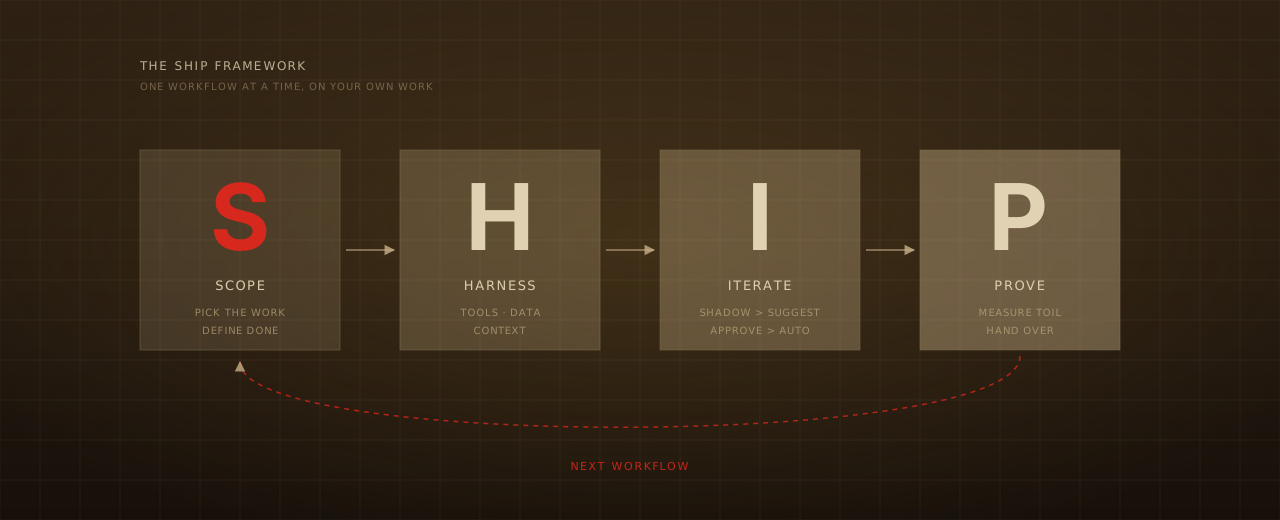
SHIP is Innovaite's four-step method for teaching teams to work with AI agents: Scope the work, Harness the agent with tools and context, Iterate while it earns autonomy, and Prove the result. Teams learn it on their own live workflows. Each cohort finishes by shipping a real automation.
Most companies train staff on AI with a license and a prompt workshop. People leave with a few tricks and go back to a full inbox. A month later? They're working exactly the way they did before. What closes the gap is practice on work people already own, with someone checking the result.
Why one-off AI workshops don't stick
A workshop teaches a tool in the abstract, while adoption happens on a Tuesday afternoon with a real deadline, so if nobody has picked a task, hooked the agent up to the systems that task lives in or agreed on what a good result looks like, people fall back on the method they trust.
Agents also change the skill being taught. Prompting a chatbot is mostly a writing skill. Running an agent means deciding what it may touch, checking its work and knowing when to take control back, which puts it a lot closer to managing a new hire than to writing a good prompt.
What is the SHIP framework?
It's the framework we teach in every training track and the one we use on every workflow we build ourselves, taking a task your team does by hand and turning it into one where an agent handles the tedious part, safely and in production.
Scope: choose the work and define done
Pick a task that repeats and eats real hours. It has to be measurable. Before anyone opens a model, agree on what "done" looks like and what it's worth. A good first scope fits on an index card: the task, who owns it today, how long it takes, how you'll know the agent got it right.
Harness: give the agent tools, data and context
The agent needs access to the systems the task touches and to the data it reads, but it also needs the context a person would have: the playbook, the policy, a few examples of the task done well. Then you design the loop it runs (perceive, plan, act, observe) and decide what it's allowed to do at each step without asking anyone first.
Iterate: let the agent earn autonomy
There are four stages. In shadow the agent proposes and does nothing. Suggest means it drafts and a person ships. Once it reaches approve it acts after a person signs off, and in the autonomous stage it runs inside limits that have been tested. Each stage has its own evals, guardrails and audit trail. Our field guide to staged autonomy goes into the stages in more detail.
Prove: measure it and hand it over
Measure the toil removed against the baseline you set during scoping. Then hand the system to the team that owns the work and start on the next workflow, which tends to go faster because people reuse what they learned on the first one.
How do you run an agentic AI training program?
Ours runs six weeks, in this order:
| When | Stage | What happens | What you keep |
|---|---|---|---|
| Week 1 | Capability audit | We assess AI fluency across functions and pick the first cohorts, starting where new skills turn into measurable value fastest. | Fluency baseline, cohort map |
| Week 2 | Executive alignment | Half-day briefings for the board and executive team on capability, risk, governance and where the return comes from. | Governance framework, executive playbook |
| Weeks 3 to 6 | Practitioner cohorts | Hands-on cohorts work on their own workflows. To graduate, each cohort ships a real automation. | Shipped automations, certification |
| Ongoing | Champions program | Train-the-trainer sessions, a playbook library we keep updating, and quarterly fluency reviews. | Playbook library, champions network |
Designing a program yourself? Put the executive briefing ahead of the cohorts. Leaders who skip it tend to approve the training and then block the very first automation that touches a customer.
What should each team practice?
Every track applies SHIP to work the team already owns, on your own stack. Here are the kinds of first exercises we start with:
| Team | Sample first exercise | Work that moves to the agent |
|---|---|---|
| Developers | An agent that turns a written spec into a pull request with tests, in your own repo | Scaffolding, tests, migrations, triage |
| Product | An agent that summarizes a month of support tickets and research notes into a draft PRD | Research synthesis, status reports, data pulls |
| Marketing | A pipeline that turns one approved article into channel drafts, reviewed by a person before anything goes out | Content production, weekly reporting |
| Sales | Account research and call prep before each meeting, with CRM notes drafted afterward | CRM updates, research, follow-ups |
| Operations | Triage of incoming documents or tickets, with fields extracted and exceptions routed to a person | Data entry, routing, reconciliation |
The specific exercise matters less than the rule behind it, which is that the task has to be one the team does every week. Practice on invented examples doesn't carry over to Monday morning.
What do executives need from agentic AI training?
Executives need less time at the keyboard and more help with judgment.
Our half-day briefing covers what agents can do today, where the risks sit, how governance works and where the return comes from, all from an operator's point of view. What you want out of it is a short list of decisions: who owns AI results, which actions always need a person, how the first workflows will be judged. Those are operating-model questions, the kind we keep apart from the technical layer when we write about the two side by side in AI operating model vs AI operating system.
How do you measure AI training?
Count what changed in the work. Attendance and satisfaction scores tell you people showed up; these tell you whether anything moved:
- Automations shipped per cohort, and how many are still running a month later.
- Hours of toil removed on each workflow, against the baseline from scoping.
- Review time per agent output. It should fall as the agent climbs the autonomy stages.
- Error and rework rates on the workflows the cohort touched.
- How many internal champions can run a SHIP cycle without help.
You'll rarely need a survey for any of this, since most of it comes straight out of the systems the work already runs in (the CRM or the ticket queue, for instance). If you'd like help setting it up, our agentic AI training for teams runs the six-week program above on your own workflows, and you can book a free 30-minute call whenever you're ready to scope the first cohort.
Agentic AI training FAQ
What is the SHIP framework?
SHIP is Innovaite's four-step framework for agentic AI work. Scope is choosing the work and defining done. Harness is giving the agent the tools, data and context it needs. Iterate is how the agent earns autonomy, with evals, guardrails and an audit trail. Prove is measuring the toil removed and handing the system to the team.
How long does agentic AI training take?
Ours runs six weeks. Week 1 is a capability audit and week 2 is executive briefings, then practitioner cohorts take weeks 3 to 6, with a champions program carrying on after that.
What should an AI training program for employees include?
Hands-on work on the team's own workflows, one shared framework and a separate briefing for executives. You also need some way to keep skills spreading once the program ends. Each cohort should finish with an automation running in production.
How do you measure AI training?
Measure the work: automations shipped and still running, hours of toil removed against a baseline, review time per agent output, error rates. Attendance figures say little about whether the work changed.
Can the training run on our own tools?
Yes. Each track runs on your own stack, on live workflows your team already owns.